


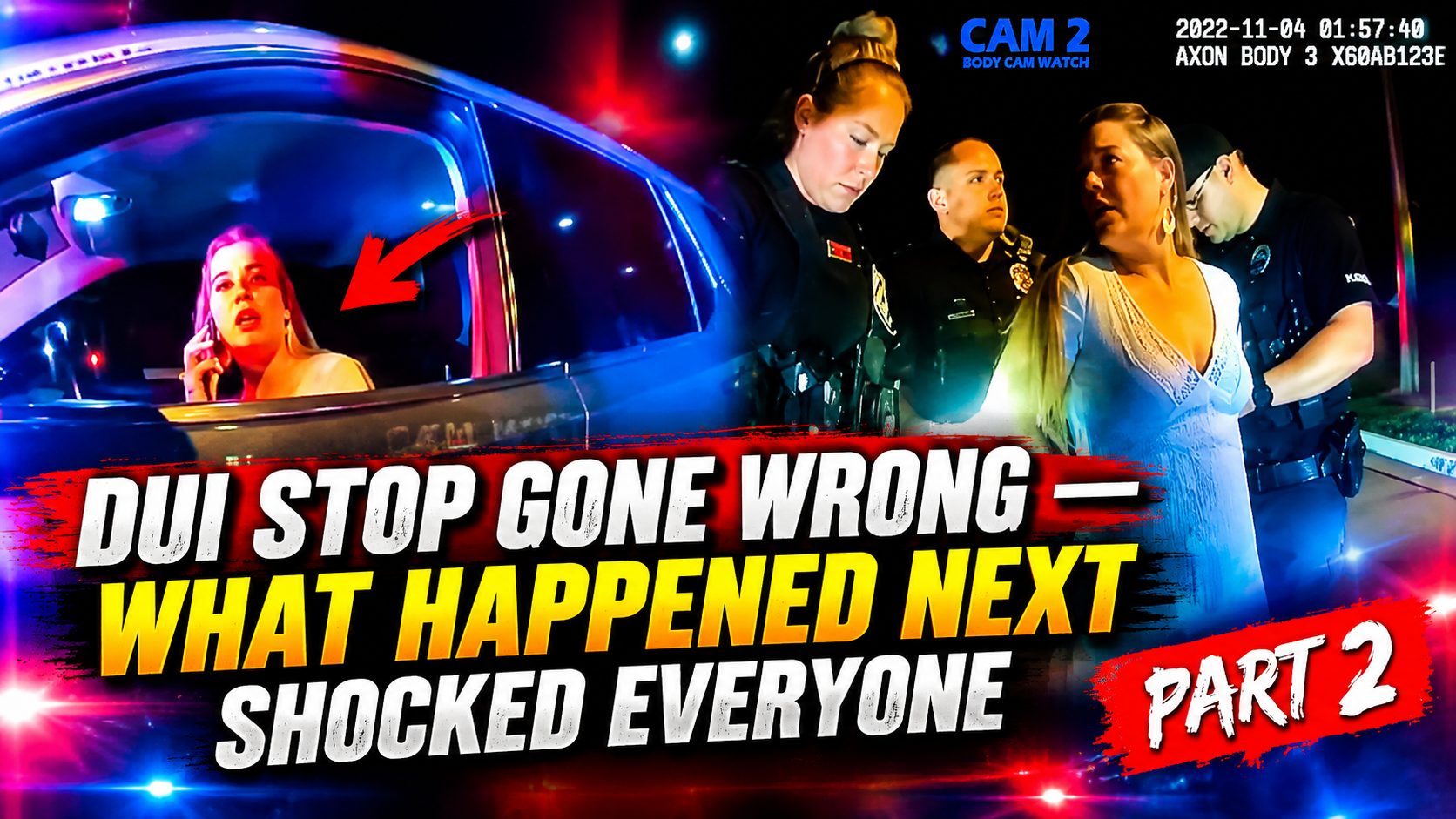
How a Routine DUI Stop Turns Physical — The Body-Cam Moments That Changed Everything
What begins as an ordinary traffic stop can sometimes become a tense and unpredictable confrontation within minutes. A driver is pulled over, an officer approaches the vehicle, questions are asked, and everyone expects the situation to be resolved quickly. But in this body-camera compilation, several traffic stops take a very different turn.
The footage provides an intense look at what can happen when officers investigate suspected impaired driving and the people involved become increasingly emotional, frustrated, or unwilling to cooperate. From nighttime roadside encounters to a daytime stop involving multiple officers, every situation develops differently — but they all share one thing in common: the tension keeps rising.
The video opens with a nighttime traffic stop. Police lights illuminate the road as an officer approaches a vehicle and begins speaking with the driver. At first, the interaction appears relatively routine. The officer asks questions and attempts to determine what is happening inside the vehicle.
However, the driver’s behavior quickly attracts more attention.
As the conversation continues, emotions begin to rise. The woman behind the wheel appears increasingly upset, and the interaction becomes more difficult for the officers to control. What might have been a simple investigation starts becoming a much more complicated encounter.
Body-camera footage captures the uncertainty of the moment. Officers have to make decisions based not only on what the driver says, but also on her behavior, movements, and willingness to follow instructions.
The situation becomes increasingly tense as more officers become involved.
Rather than immediately escalating the confrontation, officers continue attempting to communicate and establish control. Their questions are repeated, instructions are given, and the driver is asked to cooperate. Yet the emotional intensity of the encounter continues to grow.
Eventually, the situation reaches a point where physical intervention becomes part of the encounter.
This is where body-camera footage becomes especially revealing. Unlike a short clip recorded from a distance, body cameras show the encounter from the officer’s perspective. Viewers can see the movements, hear the commands, and watch how quickly a seemingly ordinary traffic stop can change.
But the nighttime incident is only the beginning.
Later in the video, viewers are taken to a completely different traffic stop during the daytime. A white SUV is stopped on the side of the road, and several people are present as officers begin investigating the situation.
A woman wearing a pink shirt becomes the focus of the encounter.
The atmosphere initially appears calmer than the earlier nighttime stop, but the conversation quickly becomes complicated. The woman speaks with officers while another individual is nearby. Police continue asking questions as they attempt to understand exactly what happened.
As additional personnel arrive, the roadside becomes increasingly crowded.
The officers appear to be carefully assessing the situation while the woman continues explaining herself. At several points, the conversation becomes emotional, with the woman appearing frustrated by the questions and the attention surrounding her.
This portion of the footage demonstrates an important reality of DUI investigations: the process is not always as simple as asking someone whether they have been drinking.
Officers may need to evaluate a driver’s behavior, physical condition, coordination, statements, and overall response to instructions. When a driver becomes emotional or refuses to cooperate, even a basic investigation can quickly become difficult.
The body-camera perspective also reveals how officers communicate with one another while attempting to keep the scene under control.
As the encounter progresses, the tension rises again.
What makes these moments particularly compelling is the uncertainty. Viewers know that something serious may happen, but they do not know exactly when the situation will change. Every movement becomes important. Every instruction matters. A simple decision — stepping away, reaching toward something, refusing a command, or becoming physically resistant — can dramatically change the direction of the encounter.
And when that happens, officers have to react immediately.
The footage later returns to another nighttime traffic stop, once again showing how different a DUI investigation can look after dark. Police lights flash across the road while officers interact with a driver and examine the circumstances surrounding the stop.
The mood is noticeably different from the daytime encounter.
There is less visibility, fewer people around, and much more uncertainty. Officers must rely heavily on their flashlights, vehicle lighting, body cameras, and communication with one another.
As the investigation continues, the situation becomes physical.
The camera moves closer to the action, giving viewers a direct perspective of the struggle and the officers’ attempts to gain control. These moments are chaotic by nature. Voices overlap, instructions are repeated, and everyone is moving quickly.
For viewers watching from outside the situation, it can be difficult to understand exactly what each person is thinking in those seconds.
That is one of the reasons body-camera footage has become such an important part of modern law-enforcement discussions.
It allows the public to see encounters that might otherwise be understood only through short descriptions or secondhand accounts. At the same time, the footage also shows how complicated these situations can become for everyone involved.
A traffic stop is rarely just about a vehicle being pulled over.
There are officers trying to determine whether there is a safety risk. There are drivers who may be frightened, embarrassed, confused, or angry. There may be passengers watching everything unfold. And there is always the possibility that an ordinary interaction could suddenly become dangerous.
The incidents in this video demonstrate that reality from several different perspectives.
One of the most striking aspects of the footage is how quickly the emotional atmosphere can change. At the beginning of an encounter, everyone may appear calm. A few minutes later, additional officers may be present, commands may become more direct, and physical intervention may be required.
These changes do not always happen because of one single moment. Often, tension builds gradually.
A question is answered.
Another question follows.
An instruction is given.
The driver reacts.
Officers respond.
And eventually, the situation reaches a critical point.
For anyone watching this type of footage, it is important to remember that body-camera videos capture only the events shown in the recording. They provide valuable visual evidence, but understanding the complete circumstances of an incident may require additional information, including police reports, witness statements, court records, and other available evidence.
Still, there is no denying the intensity of these encounters.
The footage shows just how unpredictable DUI investigations can become and why officers repeatedly emphasize communication and compliance during roadside encounters.
It also serves as a reminder that decisions made during a traffic stop can have serious consequences.
For drivers, the safest approach is generally to remain calm, keep hands visible, follow lawful instructions, and avoid turning a stressful situation into a confrontation. For officers, every traffic stop carries its own risks and requires constant awareness of changing circumstances.
Ultimately, these body-camera incidents are more than dramatic moments caught on video. They offer a closer look at the complicated reality behind traffic enforcement — where a routine stop can become an emotional confrontation in a matter of minutes.
The flashing lights, raised voices, tense conversations, and sudden physical struggles captured in this footage show how quickly control of a situation can disappear.
And perhaps the biggest lesson from the entire compilation is simple:
You never really know how a traffic stop will end when it first begins.
What appears to be an ordinary roadside interaction can develop into something far more serious, leaving officers, drivers, passengers, and witnesses dealing with the consequences long after the cameras stop recording.